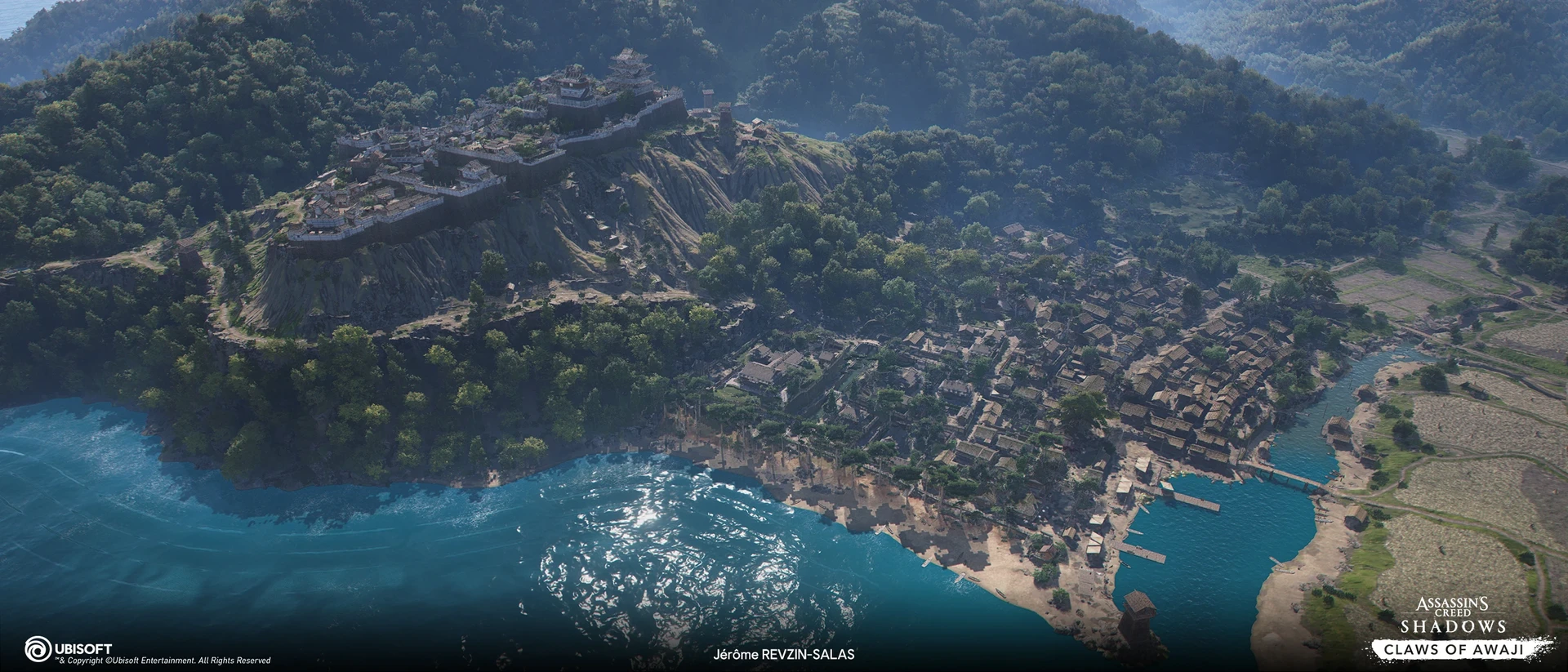
Sumoto Town
Alongside Sumoto Castle, I was responsible for the design of Sumoto Town from initial conception through to L1. Working with Clément Borja and Cristel Mrowka (Level Art), we prioritized authenticity by strictly respecting the town's historical geography, the placement of key landmarks, and its major road networks.
As the largest town on Awaji Island, Sumoto holds a highly strategic position: nestled beneath the protection of the castle and bordered by the sea. The town is naturally enclosed by water (sea and river) and mountains, surrounded by sprawling fields.
Access is limited to three bridges connecting the fields to the town. These bridges act as a tactical filter to control movement and ensure security, creating a clear defensive gradation from the unprotected fields to the fortified town center.
The layout also reflects a social and military gradation:
- Military Presence: The rural and lower-class districts have minimal security, while the Samurai and wealthy districts are heavily guarded.
- Verticality & Status: Social hierarchy is expressed through elevation; wealthier areas are built on higher ground, closer to the castle. For the player, "higher" instinctively signals a more private and restricted space.
The town is divided into several districts:
- Civilian Zones: Harbor, residential district, "bad alley", market street, samurai district, and a shrine.
- Red Zones: Ashigaru district and the Samurai residence.
We tailored every zone to accommodate numerous quests and world activities, with a constant focus on player flow, sightlines, and pacing.
Thanks to everyone who collaborated with us to make it feel alive and authentic. Finally, thanks to Cristel for the screenshots.